
 English
 العربية
 Français
 Deutsch
 Italiano
 日本語
日本語 한국어
한국어 Polski
 Português
 Русский
 Español
 ภาษาไทย
 Türkçe
 Українська
 Tiếng Việt
In the world of heavy-duty machinery and commercial trucking, every component plays a crucial role in the overall performance, safety, and longevity of the vehicle.
While engines and transmissions often steal the spotlight, it is the humble, unassuming parts that frequently serve as the true backbone of operational integrity.
Among these critical yet understated components is the torque rod bush, a masterfully engineered product that sits at the heart of a vehicle’s suspension and chassis system.
Grasping its importance is key to understanding vehicle dynamics, maintenance priorities, and ultimately, the economics of running heavy equipment.
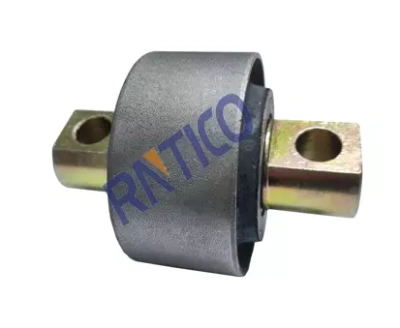
The meaning of the torque rod bush
To begin with, let’s clarify what a torque rod bush actually is.
Essentially, it is a vibration-damping product constructed through a process of rubber-metal bonding.
Manufacturers mold a robust, flexible rubber element—often reinforced with various polymers for durability—and permanently bond it between an inner and outer metal sleeve.
This assembly then gets pressed into the ends of a torque rod, also known as a radius rod.
This rod is a vital link connecting the vehicle’s axle to its chassis or frame.
Consequently, the torque rod bush becomes the pivotal interface that allows for controlled movement and force management between these two major structures.
The indispensable component
Now, why is this specific component so indispensable? The answer lies in its multifaceted function.
Primarily, the torque rod bush serves as a sophisticated pivot point.
It manages three fundamental forces: the fore-and-aft thrust generated during acceleration and braking, the lateral forces experienced during cornering, and the twisting (or torsional) forces from the axle as it articulates over uneven terrain.
Unlike a rigid metal joint, the elastic nature of the rubber core allows it to absorb and dampen these forces.
Therefore, it acts as a crucial shock absorber for the chassis, isolating the frame and, by extension, the driver and cargo, from the severe shocks and vibrations originating at the wheels.
Impact on vehicle stability and handling
Furthermore, this damping function has a direct and profound impact on vehicle stability and handling.
A correctly functioning torque rod bush maintains the precise geometric relationship between the axle and the chassis.
It ensures that the axle does not shift excessively forward or backward under braking or acceleration. This phenomenon is known as axle wind-up.
By controlling this movement, the bush guarantees that the wheels remain properly aligned, ensuring predictable steering, stable cornering, and consistent tire contact with the road.
In essence, it is a guardian of vehicle stability, providing the driver with confidence and control, especially when navigating challenging conditions with a heavy load.
The guardians of valuable vehicle components
Moreover, the importance of the torque rod bush extends to the protection of other valuable vehicle components.
Imagine the incredible forces at play in a fully laden truck; without the cushioning effect of the rubber bush, every jolt and shock would transfer directly through the rigid torque rod into the chassis mounting points.
This would create immense stress concentrations, leading to premature metal fatigue, cracked mounting brackets, and even damage to the frame itself.
The constant jarring would wreak havoc on other sensitive parts of the vehicle. Including the steering system, the transmission, and the cab mounts.
By acting as a sacrificial buffer, the torque rod bush effectively safeguards the entire vehicle from these destructive vibrational energies, significantly reducing wear and tear on adjacent systems.
Failure signals of the torque rod bush and Maintenance
However, like all components, torque rod bushes are not immortal.
They undergo constant stress, flexing, and exposure to extreme temperatures, road chemicals, and ozone.
Over time, the rubber can degrade, becoming brittle and developing cracks, or soften, deform, and lose its structural integrity.
The metal sleeves may also become loose in their housings. The symptoms of a failing torque rod bush are unmistakable and serious.
Drivers often report a noticeable increase in vibration and harshness, feeling every bump transmitted directly through the chassis.
More alarmingly, they might experience clunking or banging noises from the suspension during acceleration or braking. That is a clear sign of excessive play.
This deterioration also leads to vague steering, uneven tire wear due to misalignment, and a general feeling of the vehicle being loose or unstable.
Hence, recognizing these warning signs and prioritizing timely inspection and replacement is not merely a maintenance task; it is a critical safety and economic imperative.
Neglecting a worn bush can trigger a costly cascade of failures.
For instance, the resulting axle misalignment will rapidly destroy expensive tires.
The uncontrolled forces can then break the torque rod itself or tear its mounting points from the frame, leading to exorbitant repairs and, most dangerously, a potential loss of vehicle control.
Conclusion
The torque rod bush is a paradigm of engineering elegance, a simple-looking part performing a remarkably complex and vital job.
It’s far more than just a piece of rubber and metal. It is a fundamental pillar of safety, stability, and component longevity.
It quietly and efficiently manages the immense forces that would otherwise shake a heavy vehicle apart. Also, it ensures a smoother ride, precise handling, and protection for a wide array of other components.
For fleet managers and owner-operators, understanding and respecting the importance of this small component can lead to significant benefits. Such as enhanced safety on the road, reduced long-term maintenance costs, and improved overall vehicle performance.
Ultimately, in the demanding environment of heavy trucks and construction machinery, the torque rod bush proves that the smallest parts often bear the greatest responsibility.
RNTICO has developed a wide range of torque rod bushings; specific OEM part numbers can be found on our product pages.
Additionally, we offer custom development services for torque rod bushings. Our experienced engineering team can design and manufacture products tailored to your exact performance requirements.