
 English
 العربية
 Français
 Deutsch
 Italiano
 日本語
日本語 한국어
한국어 Polski
 Português
 Русский
 Español
 ภาษาไทย
 Türkçe
 Українська
 Tiếng Việt
In the world of heavy machinery and precision engineering, although the application of chevron springs is widely used, they often escape public notice despite their critical importance.
It’s a rubber-to-metal bonded element that serves as a fundamental piece in the suspension systems of railway vehicles.
Its primary function revolves around absorbing vibration and providing elastic support within the bogie, the chassis that holds the wheels of a train.
However, to view this component solely as a simple shock absorber would be a mistake.
Its true significance emerges when one considers its broader applications, the principles behind its design, and the potential it holds for innovation across various fields of mechanical engineering.
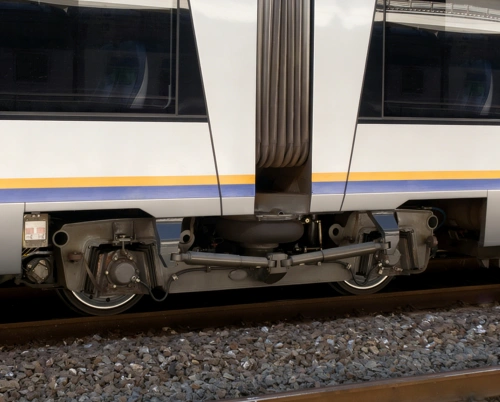
The Essential Role of Railway Bogies
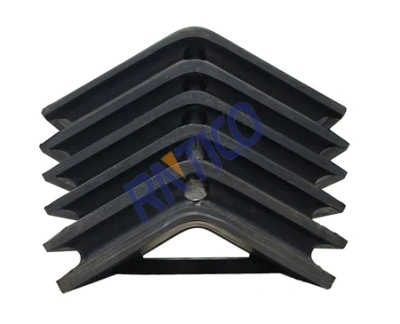
First and foremost, its distinctive V-shaped or chevron pattern defines the chevron spring, which is also the origin of its name.
This specific geometry is not merely aesthetic. It represents a sophisticated solution to a complex engineering problem.
In a traditional bogie, the space is limited, yet the demands for stability, comfort, and durability are extremely high.
The chevron spring addresses these demands by combining two materials with contrasting properties: hard, load-bearing metal and flexible, energy-absorbing rubber.
Through vulcanization, these materials are bonded inseparably, creating a single unit that can support substantial vertical loads while simultaneously allowing controlled lateral and rotational movement.
This dual capability is essential for a train navigating curves. Because it reduces wear on the wheels and rails while ensuring passenger comfort remains uncompromised.
Beyond its mechanical function, the chevron spring plays a vital role in the longevity of the entire rail system.
When a train travels at high speed, the interaction between the steel wheel and the rail generates significant dynamic forces.
Without an effective damping system, these forces would transfer directly into the vehicle’s structure, leading to rapid fatigue, increased maintenance costs, and a harsh ride experience.
By strategically placing chevron springs between the axle box and the bogie frame, engineers create a buffer that dissipates these forces as low-grade heat within the rubber compound.
Consequently, the metal components of the bogie experience less stress, and the overall lifespan of the rolling stock is extended substantially.
Beyond the Rails: Expanding Horizons
Transitioning to a broader perspective, the underlying design philosophy of the chevron spring finds relevance far beyond the railway industry.
In any mechanical system where vibration isolation is critical, one can identify analogous applications.
For instance, in industrial manufacturing, precision machinery such as lathes, milling machines, and semiconductor fabrication equipment requires an environment free from external disturbances.
Even minute vibrations can compromise the accuracy of these machines, resulting in defective products.
While traditional solutions often involve active damping systems or massive concrete foundations, the passive, fail-safe nature of the chevron-style mounting presents a compelling alternative.
By scaling the geometry and selecting appropriate rubber compounds, engineers can design custom mounts that provide predictable stiffness characteristics in multiple directions. It’s similar to the way a bogie spring manages vertical, lateral, and longitudinal forces simultaneously.
Furthermore, the adaptability of this technology extends to the automotive sector, particularly in the realm of off-road and heavy-duty vehicles.
Vehicles that operate in rugged environments, such as mining trucks or military transport, encounter constant impacts and torsional stresses.
Conventional coil springs or leaf springs, while effective, often struggle to provide the same level of multi-directional compliance found in a bonded rubber-and-metal system.
A chevron-type suspension element could potentially be integrated into the suspension arms or the chassis mounts of these vehicles, offering a compact unit that isolates the cabin from terrain-induced shocks.
In such scenarios, the chevron spring would function not just as a suspension component but as a structural link that also filters out high-frequency noise. Thereby improving operator comfort and reduces driver fatigue during long shifts.
From Vehicles to Structures: Chevron Springs in Civil Engineering
Another promising avenue for application lies in the field of building construction and civil engineering.
Modern architectural trends favor open floor plans and the use of lightweight materials. However, these designs are often susceptible to vibrations caused by wind, foot traffic, or nearby machinery.
Base isolation systems, which aim to decouple a building from ground motion during earthquakes, typically rely on laminated rubber bearings.
These bearings share a conceptual lineage with the chevron spring. Because they both depend on the shear strength and flexibility of reinforced rubber.
Extending this concept, one could imagine using chevron-shaped elements in bridge bearings or the supports for heavy machinery within factories.
The chevron pattern, with its ability to distribute stress evenly across the bonded interface, could provide a more compact alternative to traditional cylindrical or rectangular isolators. Particularly in scenarios where space constraints are a primary concern.
Innovation in Material Science and Sustainable Design
Nevertheless, the widespread adoption of chevron spring technology across different industries requires careful consideration of material science and manufacturing precision.
The rubber compounds used in these components must be selected based on the specific operating environment. Including temperature extremes, exposure to chemicals, and the frequency range of the vibrations to be isolated.
A compound that performs exceptionally well in the temperate climate of a European railway might fail prematurely in the desert heat or in the presence of industrial lubricants.
Similarly, the bonding process between the rubber and the metal must be flawless. Because any defect at the interface can lead to delamination and catastrophic failure.
Advances in computational modeling and finite element analysis now allow engineers to simulate the behavior of these springs under complex loading conditions. This allows engineers to optimize the design before producing a prototype.
Moreover, the role of chevron springs in the context of sustainability deserves attention.
In today’s world, extending the lifespan of existing infrastructure is just as important as building new systems. The durability of these components contributes directly to resource conservation.
A railway bogie equipped with high-quality chevron springs requires less frequent overhaul. Thus, it reduces the need for replacement parts and related manufacturing energy consumption.
When these springs do reach the end of their service life, the potential for recycling the metal components and reclaiming the rubber through pyrolysis or other advanced processes presents an opportunity to close the material loop.
Therefore, the application of chevron springs is not solely an engineering decision but also an environmental one. It aligns with the broader goals of circular economy principles.
Conclusion
In conclusion, while the chevron spring originated as a specialized component for railway bogies, its applications extend far beyond railway tracks.
From industrial machinery to automotive suspensions, the underlying principles of bonded rubber-to-metal isolation offer versatile solutions to pervasive engineering challenges.
The unique geometry of the chevron pattern provides a compact, durable, and multi-functional means of controlling vibration and managing structural loads.
As engineers continue to push the boundaries of what is possible in terms of material science, manufacturing precision, and sustainable design, the chevron spring stands as a testament to the power of a simple yet elegant idea.
The creativity of those who seek to harness its potential will likely limit its future applications. It proves that sometimes the most profound innovations lie in the thoughtful refinement of proven technologies.
RNTICO has focused on chevron springs for decades. We insist on using high-quality raw materials to produce products in order to meet the diverse needs of our customers.
Please feel free to contact us if you have demands on the chevron springs.
Frequently Asked Questions
Q: What products does RNTICO mainly manufacture?
A: RNTICO is a leading Chinese supplier of high-quality rubber products, integrating R&D, production, and sales.
Its main products include various types of anti-vibration rubber parts and rubber-to-metal bonded parts.
Including chevron springs, bolster springs, shear mounts, engine mounts, rubber seal strips, car mats, and other anti-vibration rubber components.
Q: Can RNTICO produce the customized rubber-to-metal bonded products?
A: Yes, RNTICO can develop and produce customized rubber-to-metal bonded products according to the client’s drawings or performance requirements.
Q: Which industries are RNTICO‘s main products applied to?
A: RNTICO can produce rubber products suitable for various industries.
Such as heavy-duty trucks, construction machinery, railway vehicles, and home applications, based on the client’s requirements.
Q: What are the advantages of RNTICO products?
A: RNTICO can independently design rubber formulations according to product requirements. Products can meet requirements such as wear resistance, high-temperature and low-temperature resistance, acid/alkali resistance, and high elasticity.
Q: What’s the minimum order quantity of RNTICO products?
A: The minimum order quantity for RNTICO products depends on the actual product size. Please contact us via WhatsApp at 86-18149510829 or sales@rntico.com for details.
Q: How should I send the inquiry or place the order to RNTICO?
A: You can contact RNTICO staff via WhatsApp: 86-18149510829 or sales@rntico.com to send the inquiry or place the order.