
 English
 العربية
 Français
 Deutsch
 Italiano
 日本語
 한국어
 Polski
 Português
 Русский
 Español
 ภาษาไทย
 Türkçe
 Українська
 Tiếng Việt
A rubber sealing strip is a flexible component manufactured from rubber or elastomeric materials, designed to form a tight, reliable seal between two mating surfaces.
These sealing elements are widely used to close gaps and block the ingress of air, water, dust, moisture, oil, and other contaminants. By creating effective barriers, they improve thermal and acoustic insulation, enhance weather resistance, and protect components from harsh environmental conditions.
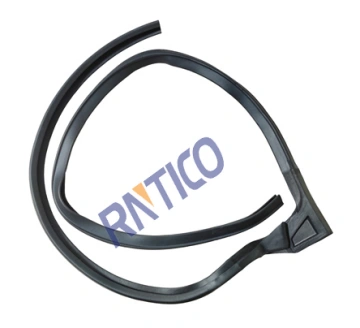
Production Procedures for Rubber Sealing Strips
The manufacturing of high-performance rubber sealing strips involves a series of precise and standardized processes:
Material Selection
The process begins with the selection of suitable rubber compounds based on the target application. Key considerations include operating environment, service temperature, usage frequency, and required sealing performance.
Common materials include:
- EPDM
- Nitrile rubber
- Neoprene
- Silicone
- Other specialized elastomers
Mixing
Raw rubber, reinforcing fillers, plasticizers, antioxidants, and vulcanizing agents are thoroughly mixed in an internal mixer to form a homogeneous rubber compound.
Laboratory tests are then conducted to verify that the compound meets strict specifications for hardness, tensile strength, elongation, and aging resistance.
Extrusion
The prepared compound is fed into an extruder to form continuous profiles. This stage supports the production of various high-performance products:
- Extruded Rubber Sealing Strip
- Dual Durometer Sponge And Solid Rubber Extrusions
- Co-extruded rubber profile with metal carrier
Co-extrusion technology allows the production of multi-layer, multi-material structures in one step, greatly improving product performance and versatility.
Curing
Extruded profiles are then cured under controlled temperature and pressure. Vulcanization forms stable cross-links within rubber molecules, giving the product excellent elasticity, resilience, and dimensional stability.
Cutting & Punching
Cured sealing strips are cut to custom lengths or punched into specific shapes using precision cutting equipment, ensuring consistency for installation and assembly.
Trimming and Finishing
Excess material is removed through trimming, buffing, or coating to improve surface quality and sealing performance. Final inspection ensures products meet strict dimensional and appearance standards.
Quality Control
Strict quality control is implemented throughout production, including:
- Machine calibration
- Real-time curing monitoring
- Physical property testing (tensile strength, compression set, weather resistance)
This guarantees every finished sealing strip meets industry and customer requirements.
Applications of Rubber Sealing Strips
Rubber sealing strips are versatile components used across nearly every major industry, providing waterproofing, dustproofing, noise reduction, shock absorption, and insulation.
Key products and applications include:
- Auto Rubber Seal Strip & EPDM Rubber Seal With Metal Insert For Car Door: Widely used in vehicle doors, windows, trunks, and engine compartments for superior sealing, noise reduction, and durability.
- Nitrile rubber strip & solutions from Manufacturers of oil-resistant rubber sealing strips: Ideal for oil-resistant sealing in engines, hydraulic systems, and industrial machinery.
- Sponge Rubber Seals: Offer excellent compressibility and cushioning for insulation and low-pressure sealing.
- Waterproof Rubber Seal Strip: Provides reliable waterproofing in construction, marine, and outdoor equipment.
Beyond sealing, these strips also provide vibration damping, thermal insulation, and anti-slip functionality in HVAC systems, electrical enclosures, industrial machinery, and conveyor systems.
Conclusion
A rubber sealing strip is an essential flexible component made from rubber and elastomeric materials, serving as a high-performance barrier against air, water, dust, oil, and noise.
With a full range including solid and sponge profiles, single and co-extruded structures, EPDM and nitrile rubber options, rubber sealing strips support reliable operation across automotive, construction, marine, electrical, and industrial fields.
RNTICO specializes in customizing rubber sealing strips and can fully meet diverse performance requirements for different industries.
If you need custom rubber sealing strips, please feel free to contact our team. We will provide you with professional and satisfactory sealing solutions.