
 English
 العربية
 Français
 Deutsch
 Italiano
 日本語
日本語 한국어
한국어 Polski
 Português
 Русский
 Español
 ภาษาไทย
 Türkçe
 Українська
 Tiếng Việt
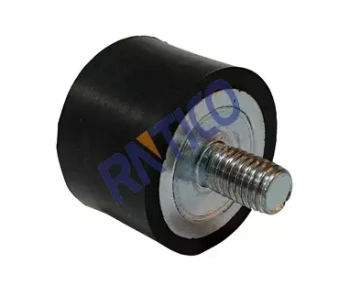
The rubber cylindrical mount, also known as a bobbin mount, is used to isolate vibrations and reduce noise between parts.
It typically has a cylindrical shape and consists of a cylindrical rubber component surrounding a zinc-plated or stainless steel core.
Production procedures for a cylindrical mount
The production procedures for cylindrical mounts will vary depending on the specific requirements of the product and the used materials.
However, a general overview of the production procedures for cylindrical mounts may include the following steps.
Design
The first step in the production process is to design the cylindrical mount.
This includes determining the dimensions, materials, and any specific features or requirements for the mount.
Material selection
Secondly, selecting the appropriate material for the cylindrical mount is crucial.
Common materials used for cylindrical mounts include metal, rubber, and plastic.
Fabrication
Thirdly, the fabrication will involve rubber vulcanization, injection, shaping, and forming the chosen material into the desired cylindrical shape.
This may involve using rubber vulcanizers, molding machines, cutting machines, and other tools.
Machining
Fourthly, if the cylindrical mount requires precision machining, this step involves using CNC machines or other equipment to achieve the required dimensions and surface finishes.
Assembly
Fifthly, if the cylindrical mount comprises multiple components, the assembly process will involve putting these components together.
This may include welding, bonding, or fastening the parts together.
Testing
Sixthly, once we assemble the cylindrical mount, it will undergo testing to ensure that it meets the required specifications and performance standards.
This may include testing for durability, strength, and vibration resistance.
Quality control
Finally, the manufacturer will inspect the cylindrical mounts for quality control to ensure they meet the necessary standards and requirements before delivery to the customer.
It’s important to note that these steps are a general overview. The production procedures for a cylindrical mount may vary depending on the requirements and materials used in the manufacturing process.
Application
Cylindrical mounts are often used in various industrial applications to reduce shock and vibration.
It can provide cushioning and support while absorbing shocks and vibrations.
They can be found in various applications, including:
Cameras and Optical Equipment
In photography and videography, cylindrical mounts are often used to attach cameras to tripods or other stabilization equipment.
They provide a stable base and allow for smooth movement.
Industrial and Mechanical Applications
In machinery, cylindrical mounts can support rotating parts or components, ensuring proper alignment and minimizing vibration.
Electronics
In electronics, cylindrical mounts may secure components like sensors or circuit boards within housings.
Automotive
In vehicles, cylindrical mounts can support engines, transmissions, or suspensions, allowing for movement while maintaining stability.
The design of cylindrical mounts can vary depending on the specific application, but they usually provide a robust and reliable way to secure components in place.
Conclusion
In general, the cylindrical mount is a mechanical component to supports or positions other parts within a cylindrical framework.
Depending on the application, it generally has a cylindrical shape and we can produce it from various materials such as metal, rubber, or plastic.
We can choose the design and material of the cylindrical mount based on the application’s specific requirements.
Such as load-bearing capacity, vibration damping, and environmental resistance.