
 English
 العربية
 Français
 Deutsch
 Italiano
 日本語
日本語 한국어
한국어 Polski
 Português
 Русский
 Español
 ภาษาไทย
 Türkçe
 Українська
 Tiếng Việt
Silicone rubber hoses have become one of the most widely used flexible tubes in modern industry and daily life. What makes them stand out from regular rubber or plastic hoses? It’s their unbeatable stability, أمان, والمرونة, especially in extreme temperatures and high-sanitation environments.
Here we’ll break down everything you need to know about خراطيم السيليكون—from the full manufacturing process to real-world uses, plus their clear advantages and downsides—to help you pick the right product for your needs.
RNTIC supports fully customized silicone rubber hoses to match your specific size, material grade, reinforcement structure, and application requirements; welcome to contact us for personalized solutions.
The Production Process of Silicone Rubber Hose
High-quality silicone hoses aren’t made by chance; they follow a strict, continuous extrusion and vulcanization process that guarantees consistent performance. Every step plays a key role in the final product quality. The following is a detailed production process.
خطوة 1: Raw Material Mixing & Preparation
First off, manufacturers start with high-purity solid silicone rubber as the base material. Then they add precise amounts of curing agents, تعزيز الحشو, color masterbatch, and anti-aging additives, following strict performance formulas.
RNTIC can customize formula ratios to meet special requirements for hardness, مقاومة درجات الحرارة, and pressure resistance.
These materials go into an internal mixer for thorough kneading, producing a smooth, uniform rubber compound. This step is crucial—it directly decides the hose’s hardness, قوة الشد, and heat resistance later on.
خطوة 2: Extrusion Molding
التالي, the mixed rubber compound is fed into a screw extruder. The machine pushes the raw material through a custom hollow mold at a steady speed, which shapes the rubber into a continuous tube blank. The mold size precisely controls the inner diameter, القطر الخارجي, and wall thickness.
RNTIC provides custom mold development to achieve non-standard inner/outer diameters, special wall thicknesses, and shaped hoses.
For hoses that need to handle high pressure, we wrap polyester fiber or steel wire braid around the tube blank during extrusion to boost durability and prevent collapse. We can customize braiding layers, مواد, and density to meet different pressure demands.
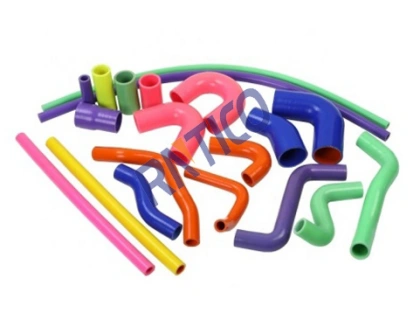
خطوة 3: High-Temperature Vulcanization
The freshly extruded tube blank enters a hot-air vulcanization furnace. At 180-250℃, a chemical cross-linking reaction happens, turning the soft raw rubber into a firm, elastic structure.
Most hoses also need a secondary post-curing treatment: they’re heated at a constant temperature for hours to remove residual chemicals, reduce deformation, and improve long-term heat stability.
RNTIC strictly controls vulcanization and post-curing parameters to ensure customized hoses meet stability and safety standards.
خطوة 4: Finishing & Quality Inspection
Once cured, the silicone hose cools down naturally. Workers then cut it to standard lengths and trim off any burrs. RNTIC supports custom length cutting, end processing, and logo printing as requested.
Before shipping, every batch passes strict quality checks—including dimensional accuracy, air tightness, tensile testing, and sanitation verification. Only qualified products make it to the market.
Practical Application Scenarios of Silicone Hoses
Thanks to their versatile performance, silicone rubber hoses fit into countless industries with strict working standards, far beyond ordinary plastic tubing.
In the medical field, platinum-cured medical-grade silicone hoses are the top pick for breathing circuits, infusion tubes, and peristaltic pump lines. They’re non-toxic, عديم الرائحة, and biocompatible, passing strict USP Class VI and FDA certifications, and can handle repeated high-temperature sterilization.
For food and beverage production, these hoses safely transfer milk, wine, hot drinks, and steam, with no weird taste or chemical leaching.
The automotive and EV industry also relies heavily on them. They work perfectly as engine cooling hoses, turbocharger pipes, and electric vehicle battery cooling lines, standing up to drastic temperature swings under the hood.
You’ll also find them in industrial steam lines, home appliance water pipes, electronic insulation parts, and even aerospace fluid systems, solving problems that regular hoses can’t handle.
Advantages and Disadvantages of Silicone Rubber Hoses
Key Advantages
Compared to PVC, إبدم, and other regular hoses, silicone hoses have clear edges.
أولاً, they handle extreme temperatures brilliantly—working steadily from -60℃ to 250℃ without hardening, تكسير, or losing flexibility.
ثانية, they’re also incredibly hygienic, with no toxic substances, making them safe for food and medical use.
ثالث, they resist ozone and weathering, have great electrical insulation, and their smooth inner wall resists buildup and is easy to clean.
Noticeable Limitations
Silicone hoses are not all perfect, though.
أولاً, silicone raw materials cost more than regular rubber or plastic, so these hoses come with a higher price tag.
ثانية, they’re not very wear-resistant, so they’re not ideal for areas with constant friction or dragging.
ثالث, they also have poor oil resistance—contact with fuel, زيت, or strong solvents will cause swelling and damage.
And long-term direct UV exposure speeds up aging, so outdoor use needs extra protection.
خاتمة
Making silicone rubber hoses requires precise extrusion and multi-stage curing technology, and their unique performance makes them irreplaceable in high-standard industries.
While they cost more and lack wear and oil resistance, their exceptional temperature resistance and safety keep them as the top choice for medical, طعام, and automotive uses.
عند اختيار خرطوم مطاط السيليكون, just match the type and specification to your working environment, and it will serve you reliably for a long time.
If you need customized silicone rubber hoses with special specifications, مواد, or functions, please contact RNTIC—we provide one-stop tailored solutions for global customers.